

Section 1: Stock Preparation – Turning Fiber into Furnish
This is where paper begins. Think of it as preparing the "dough" before baking.
Pulping: We take dry pulp sheets (or recycled paper) and mix them with water in a large pulper. Think of it like a giant blender-it breaks the material down into a slurry of individual fibers.
Cleaning & Screening: The pulp slurry passes through cleaners that spin out heavy contaminants like sand or metal, and screens that remove larger debris like plastic scraps.
Refining: This is a critical step for quality. The pulp goes between rotating discs that physically cut and fray the fibers. This "roughens up" the fiber surface, allowing them to bond together much stronger later on.
Additive Blending: Now we treat the pulp like a recipe. We add different ingredients depending on what you need:
Sizing agents: To control ink absorption (so your writing doesn't bleed).
Fillers: Like calcium carbonate, to improve brightness, smoothness, and printability.
Retention aids: To ensure these additives stay in the sheet, not just drain away with the water.
Section 2: Paper Machine – Forming the Sheet
This is the heart of the mill, where our diluted pulp mixture (which is over 99% water at this point) actually becomes a sheet of paper.
Headbox: The prepared stock is sprayed evenly onto a moving, mesh screen called the "forming fabric." This is a high-speed, precise operation to ensure the sheet has uniform weight and thickness from edge to edge.
Wire Section: Water immediately starts draining through the mesh. The fibers begin to lay down and interlace, forming a very wet, fragile sheet.
Press Section: The wet sheet is picked up by heavy felts and squeezed between large rollers. This mechanical pressure forces out more water and compacts the sheet, giving it initial strength.
Dryer Section: The sheet now travels around a series of huge, steam-heated cylinders. The heat evaporates the remaining water down to a target moisture level, usually around 5-7%.
Size Press / Coating: Depending on the paper grade, we may apply a thin layer of starch or coating color here. This seals the surface for better printing.
Calendering: Finally, the dried paper passes through polished steel rolls. This polishes the surface, giving it a smoother, more glossy finish.
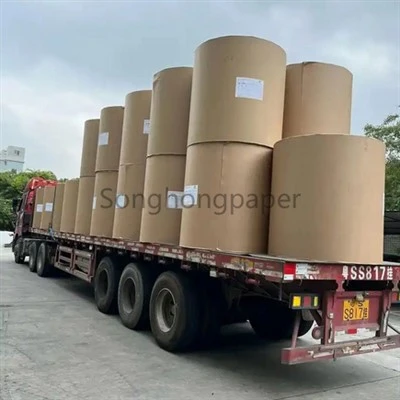
Reel: The continuous sheet is wound into a giant roll called a "parent reel," which can weigh several tons.
Section 3: Finishing & Converting – Customizing for You
This is where we turn those giant reels into the products you actually use.
Rewinding: The parent reel is unwound and slit into narrower rolls based on your order requirements.
Sheeting: If you need cut-size paper (like A4 copy paper), the rolls are fed into a sheeter that cuts them into precise sheets.
Inspection & Sorting: Every sheet or roll is checked for defects to ensure only the highest quality reaches you.
Packaging: The finished paper is wrapped, labeled, and palletized to protect it during shipping and storage.


email: 03@songhongpaper.com