If you have any needs pls contact me-
Whatsapp number of Ivy: +86 18933516049 (My Wechat +86 18933510459)
Email me: 01@songhongpaper.com
Paper books, as the term implies, are publications that use paper as their primary medium. For many readers, the immersive experience offered by physical books remains unmatched by e-books or e-ink displays. According to Marshall McLuhan's media theory, print books are classified as "cool media" due to their low sensory stimulation, which paradoxically demands greater cognitive engagement from readers. This characteristic enables deeper concentration, particularly during extended reading sessions such as those required for long-form literature. Despite advances in digital display technology, no electronic device has yet fully replicated the tactile and visual comfort provided by traditional paper. Notably, standard black-on-white printed text achieves an effective resolution exceeding 1200 dpi, surpassing the capabilities of current electronic screens.
The most essential material in book production is paper. This article provides an overview of commonly used paper types in printing and publishing.
Coated paper, internationally referred to as coated printing paper, is known as "powder paper" in Hong Kong and surrounding regions. It is a specialized paper product manufactured by applying a layer of white pigment coating onto base paper, followed by super-calendering. Available in both single-sided and double-sided variants, coated paper comes with either glossy or matte (fabric-textured) finishes. It features a smooth surface, high whiteness, and excellent ink absorption and adhesion properties. Depending on coating composition, application method, and thickness, it can be further categorized into subtypes such as single-coated, double-coated, snow-coated, and copper-coated paper.
Key characteristics of coated paper include high surface strength, superior smoothness, strong gloss, and enhanced ink receptivity, making it ideal for high-quality printed materials. It is widely used in fine halftone printing via offset and gravure processes, including premium photo albums, calendars, and illustrated books or periodicals. A notable drawback is its susceptibility to coating degradation under humid conditions-powder may flake off-and limited archival stability.
Matte coated paper, officially termed matte coated printing paper, differs from standard coated paper primarily in its reduced reflectivity. While printed images appear less vibrant, they exhibit greater subtlety and tonal refinement. Due to its superior color expression and texture, matte coated paper is frequently employed in high-end color printing applications. It is mechanically stronger and less prone to deformation than conventional coated paper, with higher ink absorption capacity and correspondingly higher production costs.
Common applications include luxury product brochures-particularly for items such as precision instruments, calligraphy, paintings, and antiques-as well as art portfolios, photography magazines, and select promotional flyers.
Offset paper, formerly known as "Daolin paper," is classified into Special Grade, No. 1, No. 2, and No. 3 based on pulp composition. It exhibits high mechanical strength and excellent printability. Available in single-sided and double-sided forms, as well as super-calendered and standard calendered grades, offset paper is considered a premium choice for book and periodical printing. It imposes strict requirements regarding contrast, dimensional stability, surface strength, and pH neutrality (slightly alkaline to neutral) to prevent chemical interactions during printing.
This paper type demonstrates low elasticity, uniform ink absorption, high smoothness, tight fiber structure, good opacity, superior whiteness, and strong resistance to moisture. Consequently, film-forming offset inks or high-quality letterpress inks with moderate viscosity are recommended to avoid issues such as powdering or linting. Backside contamination must also be prevented through the use of anti-offset powders, spray dusting, or interleaving sheets.
It is primarily used for high-quality color printing on offset presses and other printing equipment, suitable for covers, main texts, inserts, pictorial magazines, maps, posters, color trademarks, and various packaging materials.
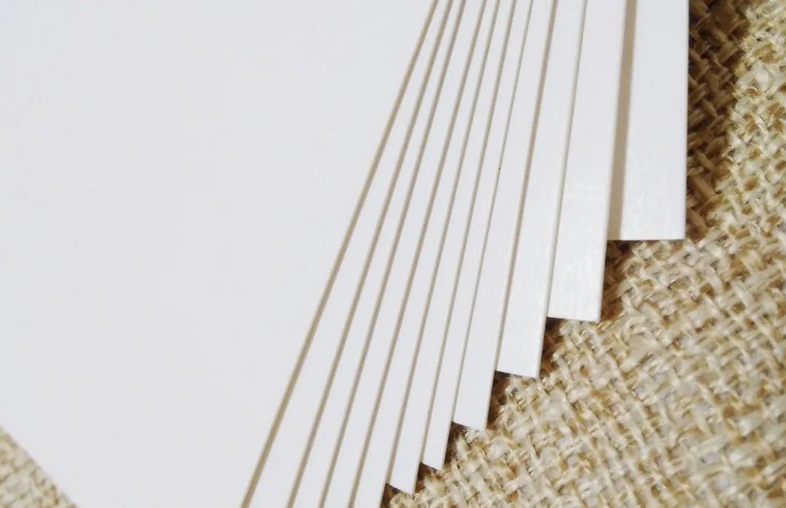
White card paper refers to a single- or multi-ply sheet made entirely from bleached chemical pulp, fully bonded throughout its structure. With a basis weight typically exceeding 150 g/m², it is designed for printing and packaging applications. Its key attributes include high smoothness, rigidity, clean appearance, and consistent quality, making it suitable for business cards, menus, and similar products.
Historically, classification systems have distinguished between paper, cardstock, and board based on grammage. White card paper has stringent whiteness requirements: Grade A must achieve at least 92% whiteness, Grade B no less than 87%, and Grade C no less than 82%. Common classifications include blue-white single- or double-sided coated card, white-back coated card, and gray-back coated card.
White cardstock denotes a thick, durable paperboard produced from pure, high-quality wood pulp. After calendering or embossing treatment, it serves as a substrate for decorative and packaging printing. Classified into Grades A, B, and C, with basis weights ranging from 210 to 400 g/m², it is commonly used for business cards, invitations, certificates, trademarks, and packaging decoration.
Pearlescent paper features a highly smooth, thick surface with strong reflective properties and a distinctive pearly luster. The effect is achieved through a layered structure incorporating mica and titanium dioxide (or other metal oxides). However, this composition results in poor ink adhesion due to the low surface energy of the coating. Ink tends to spread unevenly and dry slowly, increasing the risk of smudging. Additionally, the pearlescent finish is fragile and easily damaged during processing, contributing to higher production costs.
The primary appeal of pearlescent paper lies in its inherent visual effect. Large areas of solid ink coverage diminish or obscure the underlying luster. Therefore, design and platemaking should minimize extensive ink coverage. Optimal results are achieved with minimalistic designs featuring fine lines, patterns, or text, which preserve the paper's aesthetic while emphasizing key content elements.
Sulfate paper, also known as sulfuric acid transfer paper or tracing parchment, is a dense, film-like material formed by subjecting finely interwoven plant fibers to free beating in a wet state, without sizing or fillers. The paper is then immersed in 72% concentrated sulfuric acid for 2–3 seconds, rinsed with water, treated with glycerin, and dried. The name derives from the sulfuric acid immersion step in its manufacturing process. The resulting paper is compact, slightly translucent, and highly resistant to oil, water, and moisture penetration. It possesses high wet strength, dimensional stability, and resistance to sunlight, heat, and aging. It is also compatible with sterilization and disinfection processes.
Applications include technical drawing, CAD plotting (both pen and inkjet), electrostatic copying, laser printing, artistic reproduction, and archival documentation.
Embossed paper is a specialty decorative paper used primarily for book covers. It is available in colors such as gray, green, beige, and pink, and is typically used for single-color cover printing. Its surface features subtle concave-convex patterns created through mechanical embossing or crinkling processes applied to paper or board substrates, enhancing visual and tactile depth.
However, embossed paper is relatively brittle and resembles thin cardboard in feel. During binding, the spine area is prone to cracking. In printing, its high stiffness leads to feeding difficulties, affecting registration accuracy and overall printing efficiency.
Ovis, formally known as Ovis Premium Interior Paper, employs a proprietary coating technique that enhances surface smoothness. This results in superior color fidelity and fine tonal gradation during printing, especially in four-color process work, where it delivers exceptional image quality.
Although classified within the broader category of offset papers, Ovis distinguishes itself through its specialized coating, which imparts a smoother hand feel and improved tactile qualities compared to standard offset paper. However, due to its higher cost, only a limited number of publications currently utilize Ovis for interior pages.