If you have any needs pls contact me-
Whatsapp number of Ivy: +86 18933516049 (My Wechat +86 18933510459)
Email me: 01@songhongpaper.com
There are various methods for specifying the size of printing paper available on the market, including internationally standardized formats such as A1, A4, and others, as well as regionally used units like sheet counts and inches. These differing measurement systems and labeling conventions can often be confusing for beginners. Therefore, it is essential to understand what these size designations represent and how to select the appropriate paper based on specific requirements.
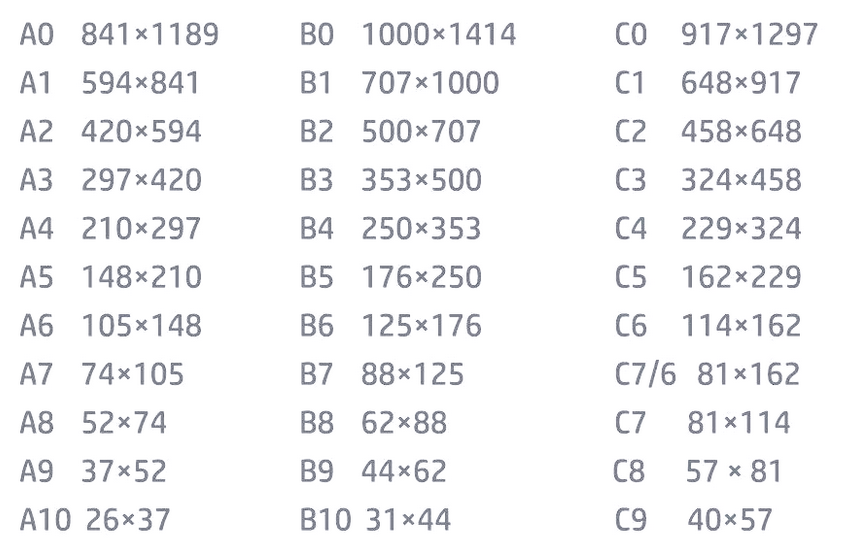
Paper sizes are primarily categorized according to their dimensions. For example, A4 paper measures 21 cm × 29.7 cm, while B4 and B5 have distinct dimensions. These standardized sizes are derived from larger parent sheets through precise trimming and finishing processes.
Historically, paper size was commonly expressed using the "kai" system-such as 8-kai or 16-kai-in certain regions. However, modern international standards now widely adopt the ISO 216 system, which uses designations such as A0, A1, A2, B1, and B2. These standards define both the aspect ratio (1:√2) between width and length and a hierarchical classification based on the base area of each format.
Specifically, the A0 format measures 841 mm × 1189 mm, with an area of exactly one square meter. The B0 size is 1000 mm × 1414 mm, covering approximately 1.414 square meters. Additionally, the C series-primarily used for envelopes-includes C0 at 917 mm × 1279 mm, with an area of about 1.173 square meters. It should be noted that standard copy paper typically adheres only to Series A and Series B specifications.
When selecting printing paper, the choice of size should align with practical needs. For instance, large-scale outputs such as charts, diagrams, or posters may require larger formats like A3 or A2. In contrast, routine office documents or small print jobs are best suited to medium-sized formats such as A4 or B5. Furthermore, factors such as paper quality, thickness, and surface characteristics must also be considered to ensure optimal print quality and equipment performance.
Among the most commonly used copy paper sizes are A3, A4, A5, A6, B4, B5, and B6. The A4 size, for example, is obtained by folding an A0 sheet four times, resulting in a final area equal to 1/16th of the original. Other sizes within the A and B series follow similar geometric progression principles.
Additionally, when an "R" or "S" prefix appears before the size designation-such as RA4 or SA4-it indicates that the paper has not yet undergone edge trimming. After trimming, such paper reaches its standard dimension; for example, untrimmed RA4/SA4 measures 240 mm × 330 mm, while the finished A4 size is 210 mm × 297 mm.
In copying applications involving enlargement or reduction, there is a standardized correspondence between original and copy paper sizes. For example, enlarging an A3 document at a ratio of 1:1.22 requires B3 paper, reducing it at 1:0.8 calls for B4 paper, and further reduction at 1:0.7 is best matched with A4 paper. It should be noted that formats such as A5, B5, and B6, though occasionally used for specialized layouts (e.g., double-column tables), are less frequently utilized in general practice.
1. Paper Thickness
Paper thickness is generally quantified by grammage-the weight per unit area, measured in grams per square meter (g/m²). For electrostatic copiers, the recommended grammage typically ranges from 64 to 80 g/m², balancing durability and feedability.
2. Paper Density
Density refers to the compactness and fineness of the fiber structure. Low-density paper with loose or coarse fibers may result in reduced image resolution and generate debris during copying, potentially contaminating internal components and causing background graying. Therefore, higher-density paper is preferred to ensure clarity and machine integrity.
3. Paper Stiffness
Stiffness, or rigidity, significantly affects paper handling during the copying process. Insufficient stiffness increases the likelihood of wrinkling or jamming due to minor resistance in the paper path, thereby impairing operational efficiency. Selecting paper with adequate stiffness ensures smooth feeding and reliable performance.
4. Surface Gloss
Surface gloss, or brightness, directly influences visual output quality. Ideally, paper should exhibit a clean white appearance without dullness. However, excessive brightness may interfere with toner adhesion and cause glare, negatively affecting readability and image fixation. A moderate level of gloss is therefore recommended.
5. Paper Dryness
Proper dryness is critical for both print quality and equipment function. High moisture content compromises the paper's electrical insulation properties, leading to faint images, gray backgrounds, and increased risk of paper jams. Consequently, selecting well-dried paper and storing it in a cool, dry, and well-ventilated environment is essential to maintain performance and prevent damage.
Furthermore, paper classification plays a role in selection and application. Common categories include Type A, Type B, and Type K, among which Type A has become the dominant standard in contemporary use. Size classifications follow a consistent proportional logic-for example, A5 is half the size of A4, and A6 is half of A5. Additionally, specialized office papers may be classified by layer count and dimensions (e.g., 241-1, 241-2) or by thickness (e.g., 60g, 70g), all of which influence printing outcomes and compatibility.